If your patio door has started to drag, grind or jump sideways when you push it, the problem is almost never the glass and almost never the lock. It is the sliding glass door rollers — the small wheel assemblies hidden in the bottom rail of the moving panel.
They carry the entire weight of the door, they wear out quietly, and by the time you notice, they have usually started damaging the track underneath.
Here is what sliding glass door rollers are, the seven signs yours are finished, why Central Florida eats them faster than almost anywhere else, and what it actually takes to put it right.
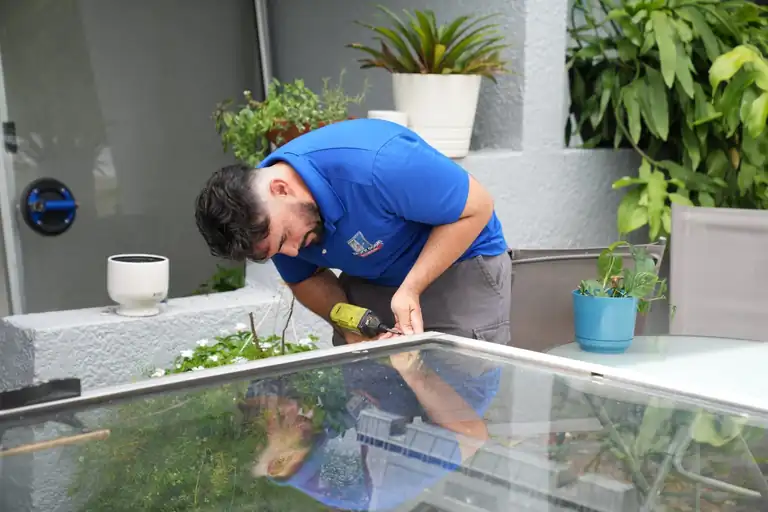
What sliding glass door rollers actually are
Every moving panel on a sliding patio door rides on two roller assemblies, one at each end of the bottom rail. Each assembly is a small housing containing one or two wheels, plus an adjustment screw that raises and lowers that corner of the panel.
That is the whole job. The rollers hold a heavy glass panel off the track, keep it square in the frame, and let it glide. When they fail, everything else about the door starts to feel wrong — the lock stops lining up, the weather seal stops sealing, and the panel starts scraping metal on metal.
Tandem rollers vs single-wheel rollers
Single-wheel rollers put the entire corner load on one small wheel. Tandem rollers use two wheels in one housing, spreading that load and riding over minor track damage far better.
Most builder-grade doors in Central Florida tract homes were fitted with the cheapest single-wheel assemblies available. That is a big part of why so many of them are failing at the ten-to-fifteen year mark.
Steel, stainless and nylon wheels
Roller wheels come in three common materials, and the difference matters more in Florida than it does up north:
- Plain steel — cheap, quiet when new, and prone to rust and seizing in humid coastal air.
- Nylon or plastic — will not corrode, but flat-spots and cracks under the weight of a large or impact-rated panel.
- Stainless steel — resists the corrosion that kills plain steel, and holds up under heavy panels. It is what we fit.
7 signs your sliding glass door rollers are worn out
Worn rollers rarely announce themselves. They degrade over years, and most people adapt to a harder and harder push without registering it. These are the tells:
- The door needs two hands. A healthy panel moves with one finger. If you are bracing and shoving, the rollers are not rolling — they are sliding.
- Grinding, crunching or squealing. That is metal wheel on metal track, usually with grit in between.
- The panel jumps or catches at the same spot every time, which is where the track has been worn into a dip.
- The door sits crooked. Check the gap along the lock stile. If it is wider at the top than the bottom, one roller has collapsed.
- The lock no longer catches without lifting or leaning on the panel. The door has dropped out of alignment.
- Visible flat spots or rust on the wheels when you look into the bottom track with a flashlight.
- A shiny groove worn into the track. This is the expensive one, and the reason not to wait.
That last point is worth repeating. Failing sliding glass door rollers do not just stop working — they machine a channel into the aluminum track beneath them. Caught early, it is a roller job. Left another year, it can become a track repair as well.
Why Florida is so hard on sliding glass door rollers
Sliding patio doors in Central Florida fail faster than the same doors in a dry climate, and there are four reasons for it.
Humidity and salt air. Plain steel wheels and bearings corrode. A seized wheel stops turning and starts dragging, and from that moment the track is being sanded down every time the door opens.
Grit. Fine sand, pollen and yard debris blow into an open bottom track constantly. Between the wheel and the track it behaves like grinding paste. Our daily afternoon storm pattern drives more of it in than most homeowners realise.
Heavy glass. Impact-rated and insulated panels are significantly heavier than the single-pane doors these roller designs were built for. If you are not sure what you have, the Florida Building Code product approval system lists what was certified for your door. More weight, faster wear.
Doors that get used. A pool deck or lanai door in Florida might cycle dozens of times a day, year round. That is a lot of revolutions on a builder-grade wheel.
Rollers, track or adjustment? How to tell them apart
Not every hard-to-open door needs new rollers, and it is worth ruling out the cheaper causes first.
- Clean the track. Vacuum it out, then wipe the channel. If the door improves dramatically, it was debris.
- Try the adjustment screws. Every panel has one at each end of the bottom rail, usually behind a small plug. Our guide to adjusting a sliding glass door walks through it.
- Look at the track surface. A crowned, dented or grooved track will destroy new rollers in months. The track has to be addressed at the same time.
If cleaning does nothing and the adjustment screws are already turned out as far as they go, the rollers are worn through and no amount of tinkering brings them back. If you are not sure which component is at fault, our breakdown of the parts of a sliding glass door shows what sits where.
Can you replace sliding glass door rollers yourself?
Honestly? Some people can. It is not a complicated mechanism. But it is a genuinely awkward job, and here is the part the video tutorials skip.
To reach the rollers, the panel has to come out of the frame. A standard sliding glass door panel is a two-person lift, and an oversized or impact-rated one is heavier still. It is tempered glass in a thin aluminum frame, and it does not forgive being dropped or racked.
Beyond the lift, three things catch people out:
- Matching the part. Roller assemblies are not universal. Housing dimensions, wheel size and screw positions vary by manufacturer and by year.
- Track condition. Fitting new rollers to a worn track is money thrown away.
- Re-hanging and squaring. Getting the panel back in, plumb, sealing and locking properly is fiddlier than getting it out.
If you want to try it, read how to remove a sliding glass door first and get a second person. If the panel is oversized, impact glass, or you are not certain what you are buying, this is a reasonable one to hand over.
What sliding glass door roller replacement actually involves
When we do it, the sequence looks like this:
- Back off the adjustment screws and lift the panel clear of the frame.
- Remove the old roller assemblies from the bottom rail.
- Inspect the track along its full length for grooving and damage.
- Fit new stainless-steel assemblies — always in pairs, never one end only.
- Re-hang the panel, set the height at both ends, and square it in the opening.
- Check that the lock engages cleanly and the weather seal closes.
Rollers are replaced in pairs for a simple reason: they wear together. Changing one and leaving its twenty-year-old partner in place guarantees a repeat visit.
Most roller jobs are finished in a single visit. Where a door takes an unusual or special-order assembly, we tell you that upfront rather than discovering it on the day.
What sliding glass door rollers cost to replace
Our pricing for roller replacement is flat and published, because vague answers on this help nobody:
- $275 for a standard sliding glass door.
- $395 for oversized and high-end doors, including Andersen and PGT.
Every part we install carries a 2-year parts warranty. If the track also needs work, or you want the full breakdown of what moves the number, we set it out on our roller replacement cost page.
Weigh that against a full door replacement. A set of sliding glass door rollers is a small fraction of the cost of a new patio door, and on a structurally sound door it buys years.
How to make new sliding glass door rollers last
Once the rollers are right, keeping them right is mostly about keeping grit out of the track:
- Vacuum the bottom track every month or two — more often if you are near the coast or a construction site.
- Wipe the channel clean rather than flooding it with oil. Heavy grease collects sand and makes wear worse.
- Keep the weep holes clear so standing water is not sitting around the rollers.
- Fix a hard-sliding door early, while it is still only a roller problem.
A door that has been looked after should not need this again for a long time. A neglected track will take out a new set of sliding patio door rollers surprisingly fast.
Frequently asked questions about sliding glass door rollers
How long do sliding glass door rollers last?
There is no fixed number, because it depends almost entirely on panel weight, wheel material and how much grit gets into the track. Builder-grade steel rollers on a heavily used Florida lanai door wear out far sooner than stainless rollers on a lightly used door that gets vacuumed.
Should I replace both rollers or just the broken one?
Both. The two assemblies on a panel have done identical work for identical years, so the second one is rarely far behind the first. Replacing in pairs also keeps the panel sitting level, which is what makes the lock line up.
Can worn rollers damage the track?
Yes, and this is the main reason not to put it off. A seized or flat-spotted wheel stops rolling and starts scraping, wearing a groove into the aluminum. Once that groove is deep enough, the track needs attention too and the repair gets bigger.
Are sliding glass door rollers and sliding glass door wheels the same thing?
Effectively, yes. “Wheels” usually refers to the rolling part itself and “rollers” to the complete assembly — housing, wheel or wheels, and adjustment screw. When a part is replaced, the whole assembly is replaced, not the bare wheel.
Will new rollers fix a door that will not lock?
Often, yes. A great many lock complaints are really alignment complaints: the panel has dropped on collapsed rollers, so the latch no longer meets the keeper. Restore the height and the lock frequently starts working again without touching the lock itself.
Get a straight answer on your door
Stuck Door is a family-owned Orlando company, licensed and insured, with a 5.0-star rating across more than 200 Google reviews. Sliding glass door rollers are the single most common repair we do, and we handle roller and wheel replacement right across Orlando.
Call (407) 900-9412 and describe what the door is doing — we will give you a ballpark over the phone at no charge. Our office is open until 6 PM. You can also use the chat assistant on the site for an instant quote, or get in touch here.
If it turns out the glass is the problem rather than the hardware, we also handle fogged and broken glass replacement, and you can see the full range of sliding glass door repair we offer, including the work we do around Orlando.